First come the ghosts from the tours. Then come the ones people tell you about only after they have known you for years.
Fernandina tells a story about a condemned privateer named Peter Short. Local legend says that on the night before he was to hang, Short tried to kill himself by cutting his own throat. A doctor was summoned to the jail and sewed the wound closed—not to save him, but to keep him alive long enough for the rope.
The next morning, they put the noose around his neck and opened the trapdoor.
In the version most often told, the wound tore open during the hanging. Blood sprayed into the crowd. People ran.
It is an almost perfect Fernandina ghost story: a privateer, an old jail, a grotesque medical favor, and a public execution that punished the spectators.
Whether every detail happened exactly as told matters less than it should. The story now lives somewhere between local history and local legend, where the most durable stories usually end up.
Folklore improves with blood.
Peter Short is one of the ghosts we prefer.
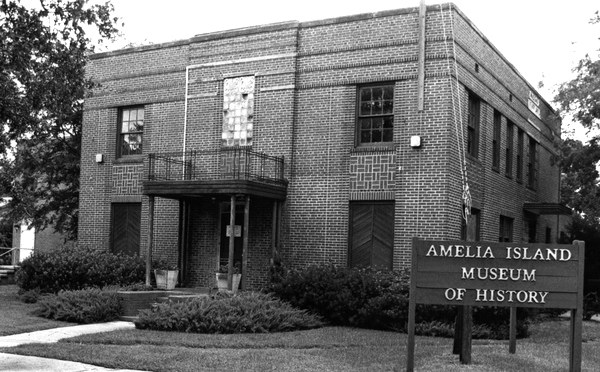
The old jail, now the Amelia Island Museum of History.
The Public Dead
Amelia Island has long understood the usefulness of a ghost.
The right one gives an old building a second life. It turns a dark staircase into an attraction and an unexplained noise into local color. It gives visitors a reason to look toward upper windows after midnight.
Our preferred ghosts are cooperative.
They occupy old jails, museums, inns, saloons, and historic houses. Charlie, a dead bartender, still tends his bar. Peter Short remains near the place where prisoners once waited. At an old inn, a woman called Lola is said to pace the upper floors and slip into bed beside sleeping guests.
The public dead come with names and explanations. Someone can point toward the building, identify the victim, describe the death, and explain why the ghost remains.
These stories frighten pleasantly.
A guide raises a lantern. The group falls quiet. Everyone looks toward the same upper window, and despite yourself, you look too.
Then the tour moves on, and the dead remain where they have been assigned.
There is comfort in that kind of haunting. The violence is old. The grief has been arranged into a story. No one listening is personally at risk. No one has to sleep in the room afterward.
These are ghosts suitable for strangers.
For the Record
I believe in ghosts.
I saw one once as a young adult, far from Fernandina. In twenty-five years here, I have never seen one.
In my household, belief generally belonged to me alone.
The skeptics were the ones frightened out of their socks.
Old houses settle. Pipes knock. Cold air finds its way through nineteenth-century walls. At the edge of sleep, the mind can produce voices, pressure, movement, even the vivid certainty that someone else is in the room.
Some excellent ghost stories are only stories.
Still, in the early 2000s, a museum employee stayed after hours and watched books leave the gift-shop shelves one at a time.
That is how an employee described it to me.
The books did not simply fall. They appeared to move outward from the shelves and cross the room.
No one was touched. No one fled the building forever. The former jail behaved exactly as a haunted former jail was expected to behave.
It was another ghost we could tell in public.
The Ghosts We Live With
The others are not offered to strangers.
They surface years later, in conversation, when someone lowers her voice.
You cannot tell anyone this, but…
Then comes the address.
The room.
The person who was there.
A husband hears voices on an empty porch. A boyfriend is knocked from a couch. A woman wakes to hands moving over her body and leaves her home before morning.
The tour ghosts make appearances.
These make contact.
That difference matters.
A figure in an upstairs window can be printed on a brochure. A dead bartender can become part of a saloon’s charm. But a presence that enters an occupied bedroom, presses against a sleeping woman, or answers a living man through a closed door is harder to make picturesque.
Public ghosts observe boundaries.
They belong to another century, preferably one with attractive buildings and incomplete records. They remain attached to places visitors can leave.
The private ghosts break those rules.
Their witnesses are still alive. Their fear is not historical. Sometimes neither is their embarrassment.
On my block, there are three old houses and a funeral home. In Fernandina’s historic district, the living and the dead are never very far apart.
The Voices Outside
One night in 2003, my former husband heard people talking on our front porch.
The house was built in 1891. The porch sits directly against the front room, and voices outside the door are unmistakable.
He heard a conversation, then footsteps crossing the old boards.
He opened the door.
The porch was empty. The sidewalk was empty.
He closed the door.
The conversation resumed.
He opened it again.
Silence.
He shut the door.
The voices returned.
He repeated this more than once. Each time, opening the door stopped the conversation. Each time, closing it brought the voices back.
He had served in the military. He did not believe in ghosts and was not a man who frightened easily.
By the time he told me what had happened, he was trembling and soaked in sweat.
What disturbed him was not simply that he had heard voices where no people could be found.
It was that the voices appeared to know when the door was open.
The following day, the funeral home on our block held a viewing.
I do not know whether those two things belonged together.
I know only that one happened after the other, which is how many ghost stories begin.
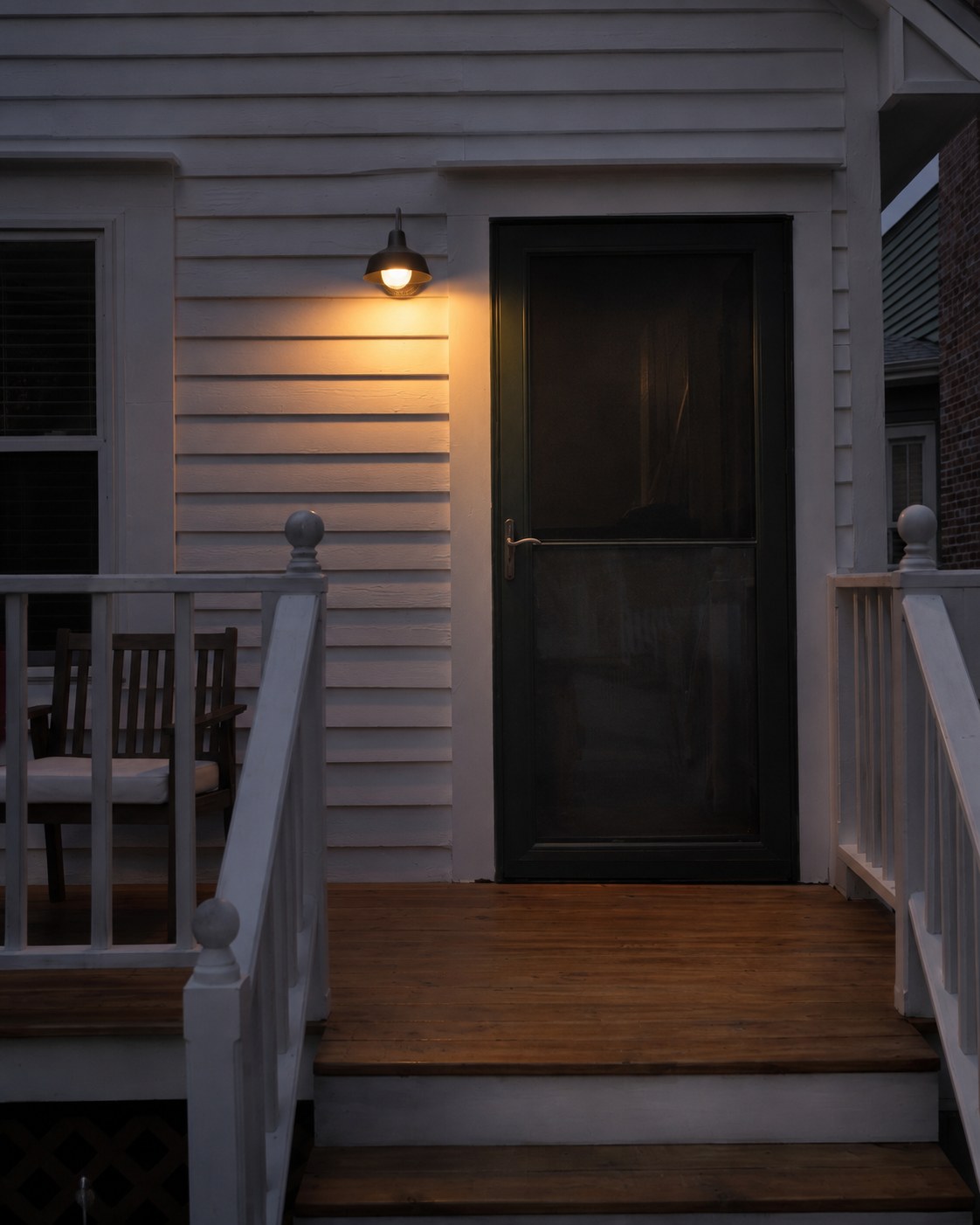
A porch in Fernandina’s historic district, where voices were heard outside an empty door.
The Living Room
Several years later, another man was alone in my house.
It was late at night. He was watching television in the living room, in one of the original parts of the 1891 house. The television cast the only light.
Something pushed him.
He turned around.
No one was there.
Then it pushed him again, hard enough to knock him from the couch and onto the floor.
He came up pale and shaking, staring at the empty space behind him.
He was built like a linebacker.
Whatever he believed before that night, something he could not see had put him on the floor.
The Man at the Foot of the Bed
In another old house, neighborhood lore tells of the same figure appearing for decades.
People wake and see a tall man with red hair standing at the foot of the bed.
He does not cross the room. He does not speak. He is simply there when their eyes open, looking down at them.
Others have reported heavy footsteps climbing the stairs toward the second-floor bedroom.
The house dates to the 1860s. According to the story passed through the neighborhood, a man was killed on the staircase sometime in the 1890s. The sightings are said to go back at least to the 1960s.
The killing remains part of the lore, not something I have independently proved.
Everyone has mistaken a coat, a shadow, or a dark doorway for a person. Usually the fear ends when the eyes adjust.
In these accounts, the man remains.
Sometimes he is seen at the foot of the bed.
Sometimes only the footsteps come up the stairs.
No one knows what waits at the top.
They know only that when they wake, he is already there.
The Former Boarding House
A Fernandina woman once lived in an apartment inside a former boarding house.
The building already had a reputation.
One night, she woke to the sensation of hands moving over her body.
No one else was in the room.
She believed she was fully awake. The touching did not stop.
She fought her way out of the bed, fled the apartment, and never slept there again. She moved out the next day.
The story never acquired a name, a costume, or a neat historical explanation.
It remained attached to a living woman, an occupied room, and an experience she did not find charming.
No guide raised a lantern outside.
No one sold a ticket.
Carlotta
Not every presence in these houses is frightening.
When a fourth-generation Fernandina resident was growing up in the south historic district, her brother said that a dark-haired woman tucked him into bed each night.
The family came to call her Carlotta.
Decades later, a couple in their sixties moved into a nineteenth-century house across the street.
The husband was a large, tough man with no particular interest in ghost stories.
One evening, he mentioned something strange.
As he drifted to sleep, he would sometimes feel the mattress sink beside him. Then someone would tuck the covers around him.
When he described the presence, he said it was a woman with dark hair.
According to the resident who told me both stories, he had never been told about Carlotta.
Across the street and decades apart, two men had described the same small kindness before sleep.
Perhaps both experienced something produced by the dreaming mind.
Perhaps an old family story traveled farther than anyone realized.
Or perhaps Carlotta simply crossed the street.
The Dead Passing Through
The same woman told me about something she saw as a child in the 1960s.
She was ten or twelve years old, sitting at the kitchen table with two cousins in broad daylight.
A dead relative walked through the kitchen with his dogs beside him.
The dogs were dead too.
She says all three children saw them.
They discussed it then. They continued discussing it as adults.
The man and the dogs moved through the kitchen and into the living room, following what seemed to be an ordinary route through the house. Then they disappeared.
There was no storm.
No séance.
No darkness.
The relative did not stop. The dogs did not turn their heads.
They passed through as though they were not visitors and the house still belonged to them.
The People They Know
After we spoke about Carlotta and the dead relative with his dogs, the woman called me again.
She said talking about the spirits had stirred things up.
Then she said something I have not stopped thinking about.
“Spirits like to be noticed,” she told me. “Especially by people they know.”
With so many newcomers moving into Fernandina’s old houses, she wondered whether some of the spirits no longer came out.
Even the dead, apparently, are cautious around outsiders.
I have lived in Fernandina for twenty-five years and have never seen a ghost.
Perhaps I am still too new.
My husband and boyfriend, however, were noticed almost immediately.
The Things Everyone Knows
When I asked the fourth-generation resident whether I could use these stories without identifying her, she agreed.
“We all know about it,” she said, “but none of us ever talk about it.”
That may be the real dividing line between the ghosts Fernandina offers its visitors and the ones it keeps for itself.
The public ghosts belong to the town. They have names, dates, historical buildings, and stories that can be repeated on schedule.
The others still belong to the living and the houses.
They are not exactly secret. Too many people know them for that.
But they are held close until someone has lived here long enough, asked in the right way, or become familiar enough to be trusted with what everyone knows and no one discusses.
That does not make the private stories more true.
It makes them harder to fit into the public version of Fernandina—the polite one, the marketable one, the one with plaques and lanterns and an ending everyone can repeat.
The public story smooths the rough edges. It names the dead, assigns them a room, and gives their violence a safe historical distance.
The private story does not cooperate.
It remains inside the house.
Walk through Fernandina’s historic district at dusk, after the heat has begun to lift and the brick sidewalks have emptied.
The cicadas will be loud. Porch lights will come on one by one. Behind the live oaks, the upper windows of the old houses will darken into mirrors.
Most will show only the last light of evening.
Look anyway.
The ghosts suitable for strangers have already been introduced.
The others do not ask permission.
They cross the porch.
They push from behind.
They tuck the covers with hands you cannot see.
And once they notice you, they follow you home.
Most of the windows will be dark. That does not mean no one is standing behind them.
Author’s Note
These accounts come from direct conversations with longtime residents, personal experience, and neighborhood lore. Names and exact addresses have been withheld. Some historical details remain unverified and are presented as local legend