Meth, informants, and Nassau County’s least stable supply chain
There is another Nassau County in the police reports.
It has methamphetamine, crack cocaine, guns, little plastic baggies and an impressive number of bad decisions made inside cars.
It also has confidential informants.
This is how it often works.
Someone gets busted.
Then someone starts talking.
He knows who sells meth. She knows where to buy crack. Somebody knows somebody who will answer the phone.
Police search the informant to make sure he is not carrying drugs of his own. They give him money. They attach an audio-video recorder. Then they send him to buy drugs from someone who knows him well enough to let him in.
That is a controlled buy.
If it works, the informant comes back with drugs and a recording. Eventually somebody gets arrested.
And sometimes that somebody starts talking too.
Spend enough time in Nassau County narcotics files and the system begins to look less like a straight line than a recycling symbol.
The buyer becomes the informant. The informant becomes a suspect. Yesterday’s suspect brings police tomorrow’s suspect. Everyone seems to know everyone else.
Occasionally, somebody manages to occupy several of these positions at the same time.
The three men in the stories that follow are called the Hustler, Fourteen and the Writer. Their real names and exact addresses have been omitted because the point is the machinery, not another round of exposure for their families.
The nicknames are ours.
The records and quotations are real.
💨 · 💨 · 💨 · 💨 · 💨
The Hustler
The Hustler got caught selling crack cocaine.
So he flipped.
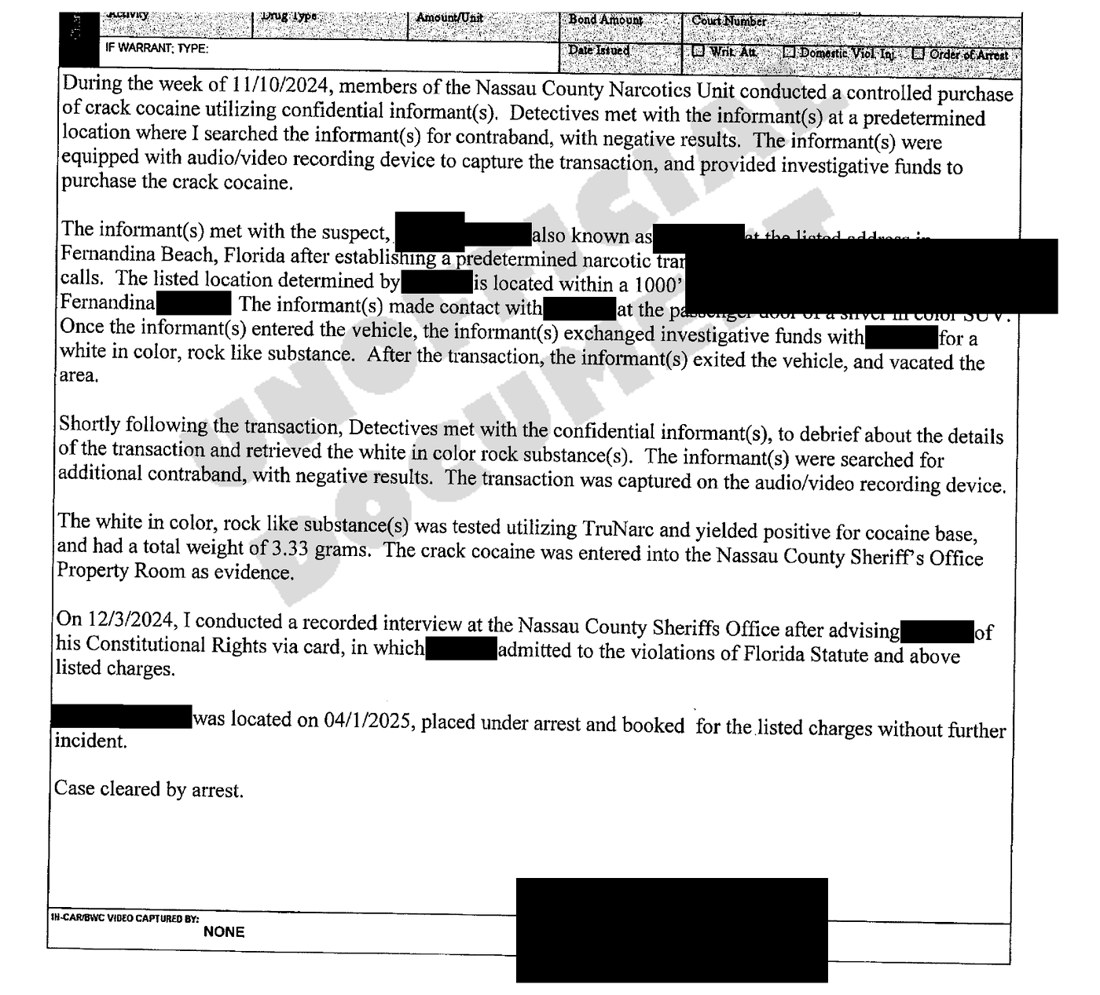
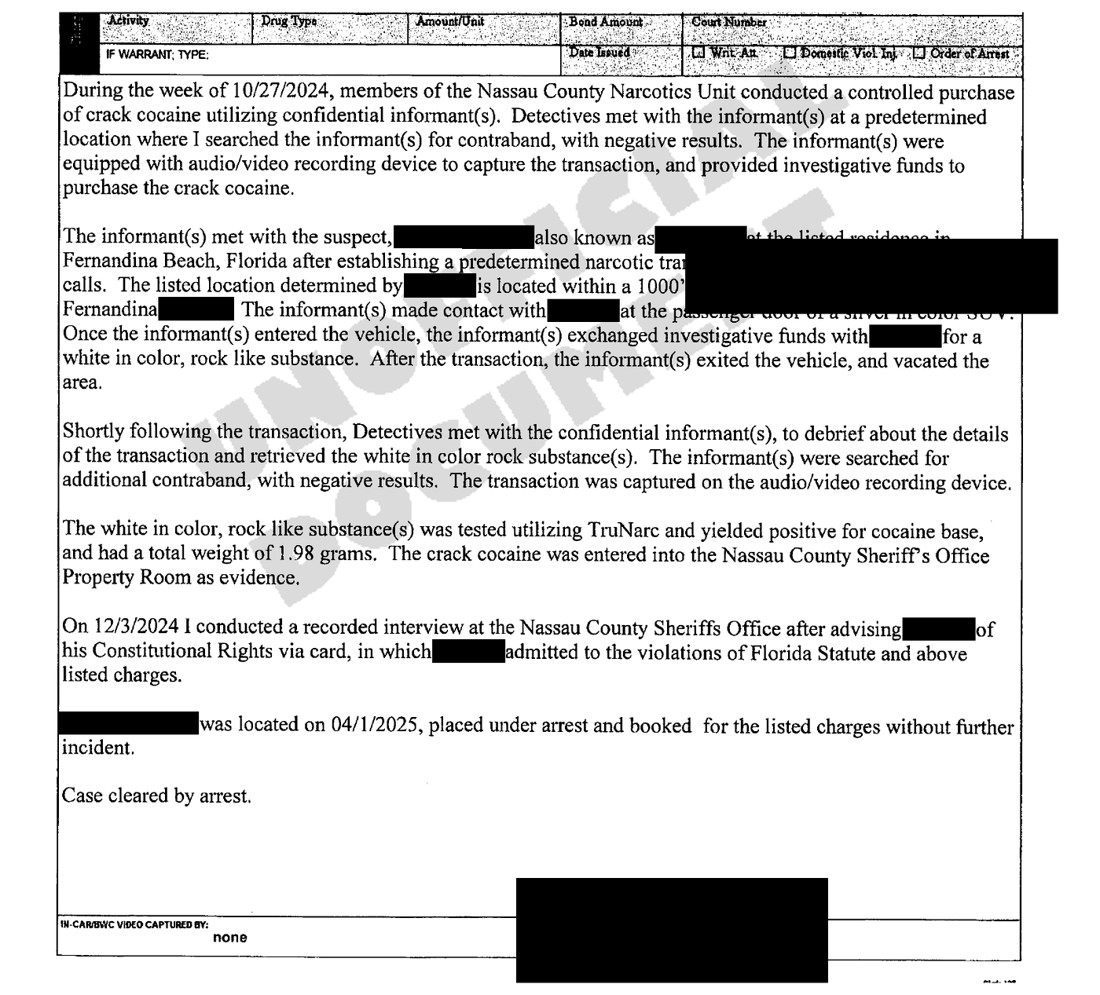
In the fall of 2024, a confidential informant made two recorded crack-cocaine purchases from him. When detectives later confronted the Hustler with the evidence, according to the arrest reports, he admitted the sales and agreed to become a confidential informant himself.
Police explained the rules.
The Hustler could not commit crimes. He could not possess firearms. And he could not create a crime himself and then hand it to police as useful intelligence.
These rules would prove ambitious.
About a month later, the Hustler called his police handler with a tip.
From the file: one of the recorded crack-cocaine buys that put the Hustler in the informant system.
Two men were heading from Nassau County to Jacksonville, he said, to obtain drugs and guns from an unknown supplier.
We’ll call the two men the Buyers.
Police decided to follow the Buyers.
Police did not tell the Hustler they were watching.
The Buyers drove to Jacksonville and met their supplier.
It was the Hustler.
The Hustler handed the Buyers a black bag. Police later stopped the Buyers’ car and found cocaine, crack cocaine and a loaded 9 mm pistol.
When detectives confronted the Hustler, he asked:
“So they got it from me?”
Yes.
They had.
“Well, I tried, man.”
Police asked where the gun came from.
“I just had a gun.”
So, to review:
The Hustler gave police the tip, identified the Buyers, supplied the drugs and supplied the gun.
He had become both the confidential informant and the criminal he was informing on.
This arrangement did not last.
From the file: another controlled-buy record, before the Hustler became both informant and supplier.
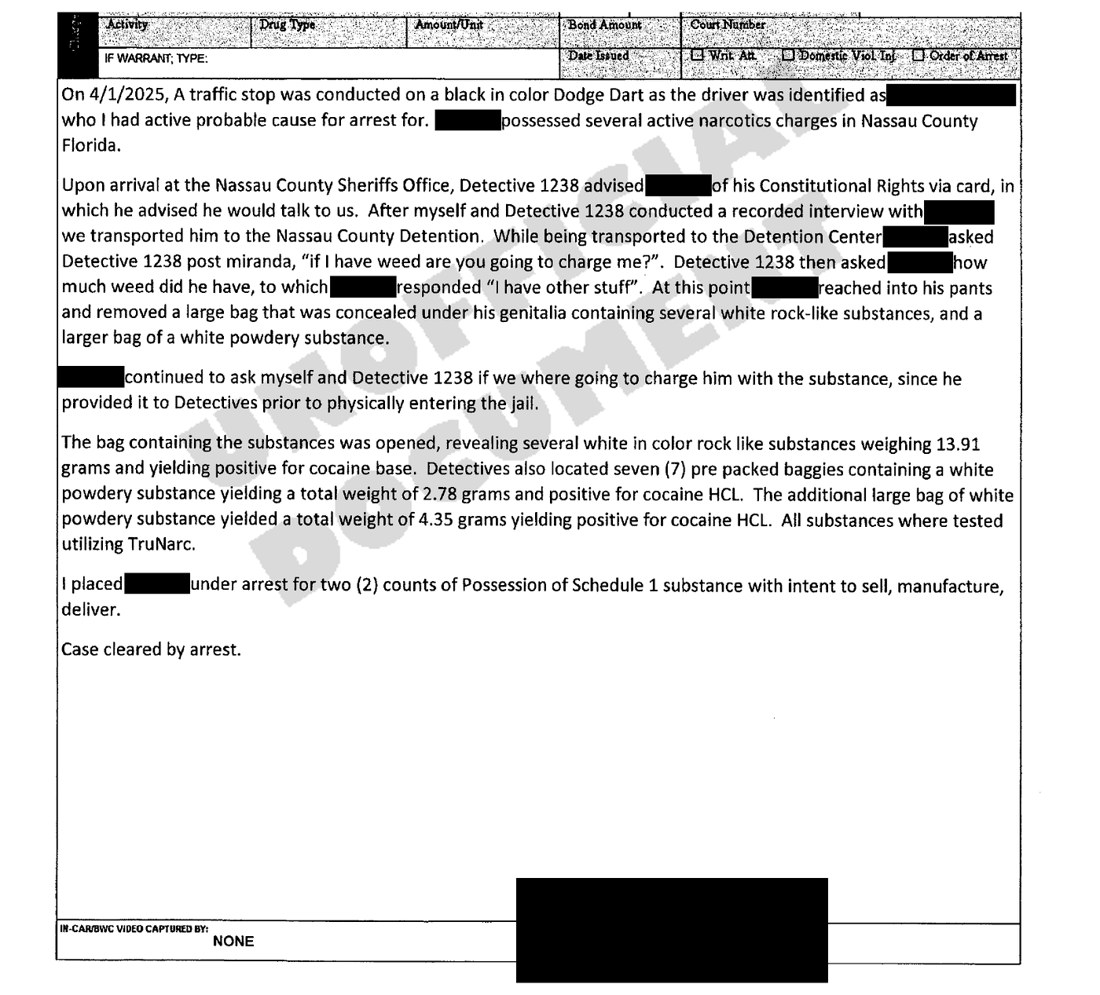
Two months later, the Hustler was arrested again. During the ride to the Nassau County jail, he asked detectives whether they would charge him if he happened to have marijuana on him.
Then the Hustler amended the disclosure.
“I have other stuff.”
According to the arrest report, the Hustler reached into his pants and produced a large bag concealed beneath his genitals. Inside were 13.91 grams of crack cocaine, 7.13 grams of powder cocaine and seven smaller baggies.
Then came the legal theory.
The Hustler repeatedly asked detectives whether they could still charge him because he had voluntarily surrendered the drugs before physically entering the jail.
There was apparently, in his mind, a border.
Cocaine outside the jail: bad.
Cocaine inside the jail: worse.
Cocaine removed from beneath one’s genitals shortly before reaching the jail: apparently worth asking about.
In August 2025, state prosecutors dropped the two controlled-buy cases and the later cocaine case. The dismissal records reviewed by Dark Amelia gave no reason.
The federal case did not disappear.
That December, the Hustler pleaded guilty in federal court to distributing cocaine and crack cocaine and possessing a firearm as a convicted felon.
His career as a confidential informant had not gone particularly well.
From the file: the later arrest report involving cocaine concealed before the trip into the Nassau County jail.
💨 · 💨 · 💨 · 💨 · 💨
Fourteen
Fourteen’s story is less funny.
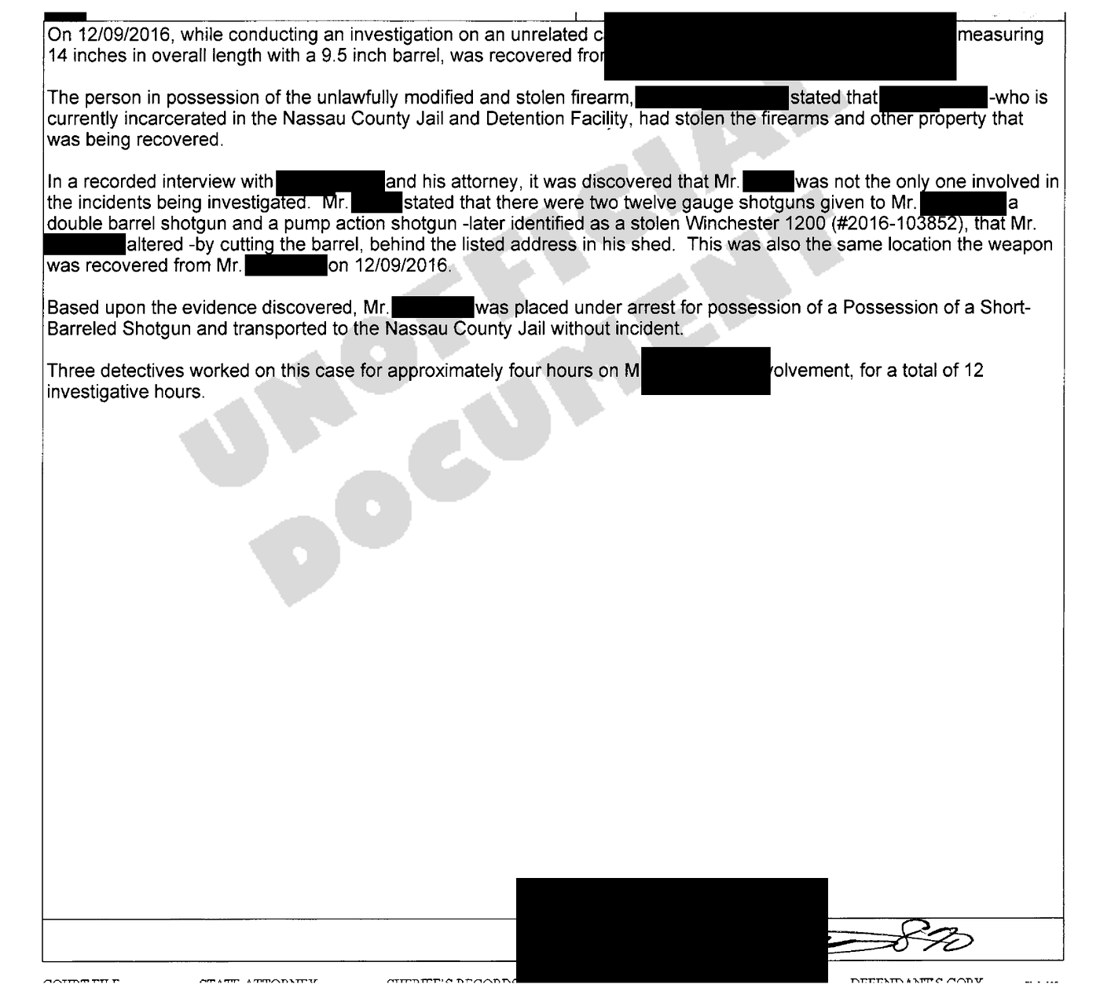
Years before narcotics detectives sent anyone to buy methamphetamine from him, deputies reported finding a double-barreled shotgun at his property.
The entire gun measured fourteen inches from end to end.
Its barrel measured nine and a half.
The arrest report described it as unlawfully modified and stolen.
Hence the nickname.
From the file: the shotgun report that gave Fourteen his nickname.
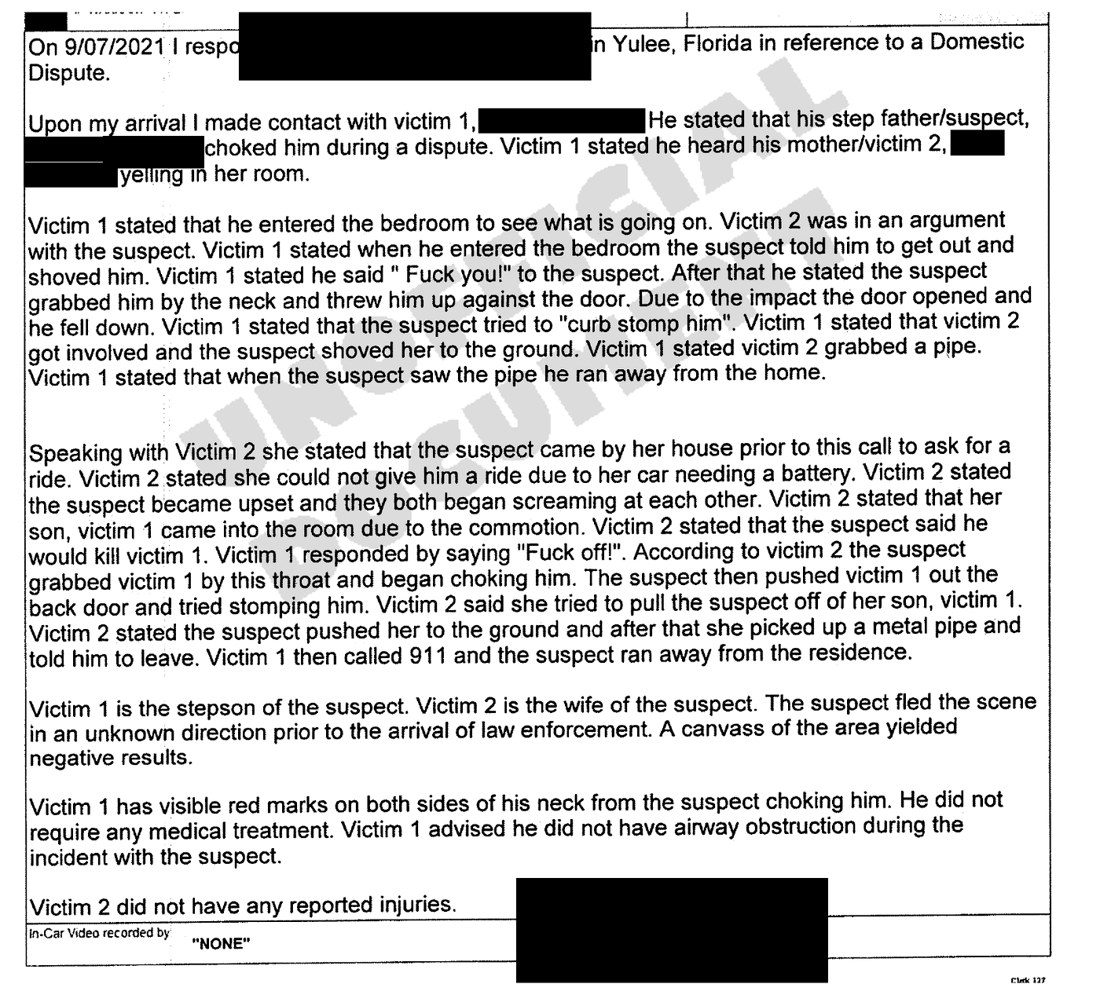
Five years later, deputies responded to a domestic dispute involving Fourteen, his wife and his stepson.
According to the arrest report, Fourteen had been arguing with his wife when her son entered the room. Fourteen allegedly grabbed him by the throat, threw him against a door and threatened to kill him.
The report says Fourteen then tried to stomp him.
When his wife attempted to pull Fourteen away, he allegedly pushed her to the ground. She picked up a metal pipe and ordered him to leave.
Fourteen left before deputies arrived.
Deputies reported visible red marks on both sides of the stepson’s neck.
The records reviewed by Dark Amelia do not establish how those earlier cases were ultimately resolved.
From the file: the domestic-dispute report alleging violence inside the family.
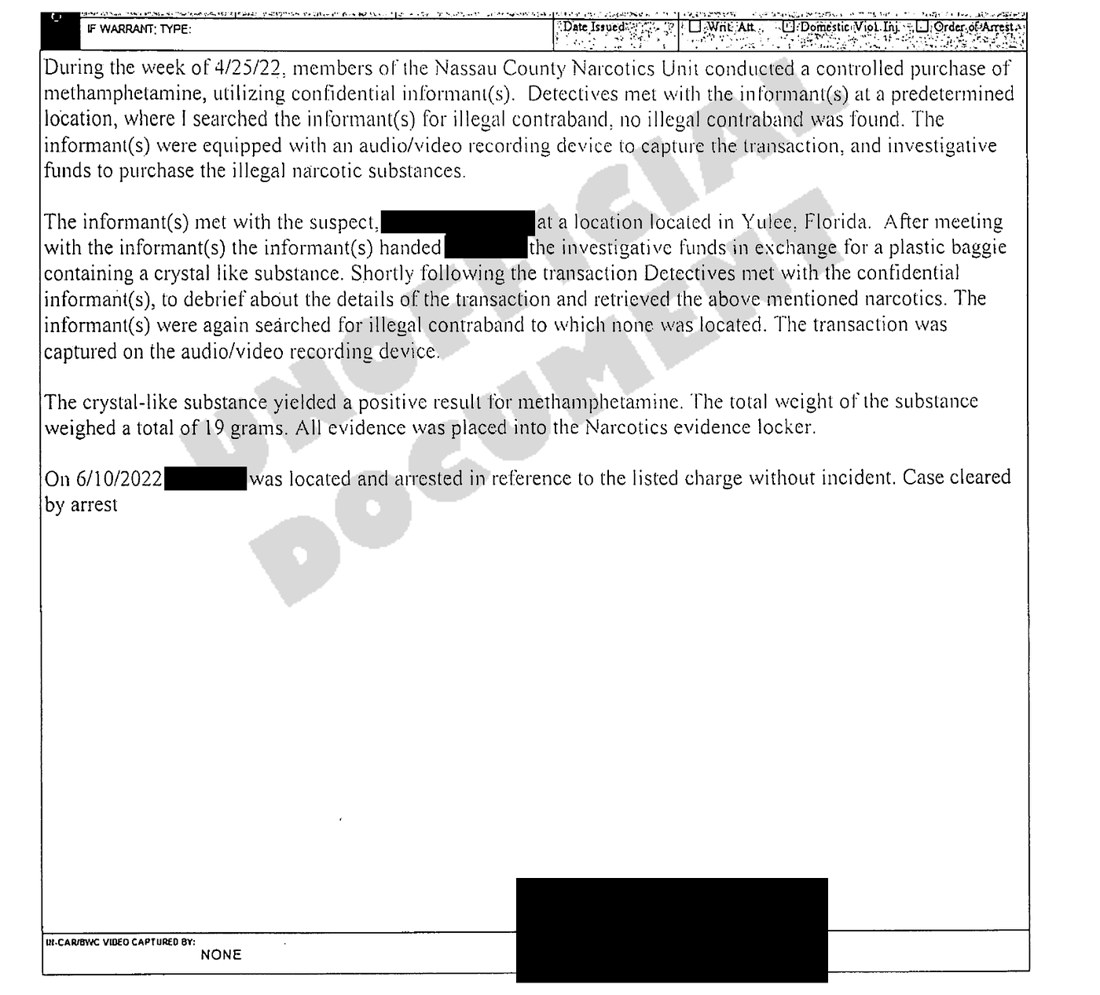
Then, in 2022, narcotics detectives wanted to buy methamphetamine from Fourteen.
This is where a confidential informant becomes useful.
A police officer cannot simply knock on every suspected dealer’s door and say he would like a trafficking quantity of methamphetamine.
A stranger may not get through the door.
Someone familiar might.
During the week of April 25, detectives sent a confidential informant to meet Fourteen in Yulee. The informant was wired and carrying police money.
He came back with methamphetamine.
The arrest report listed 19 grams. The State Attorney’s Office later reported a tested weight of 17 grams.
The transaction had been recorded.
When detectives later arrested Fourteen, he denied selling the methamphetamine.
Then they showed him a still photograph from the recording.
According to prosecutors, Fourteen acknowledged that he had been caught, although he stopped short of explicitly admitting the sale.
The case went to trial.
The jury convicted him of trafficking.
The interesting part is not that police managed to buy methamphetamine.
It is who had to do the buying.
Somebody Fourteen knew had to call him, meet him and get close enough to exchange police money for methamphetamine while carrying a recorder.
The shotgun in the old arrest report had been fourteen inches long.
The recorder was smaller.
The person wearing it still had to walk in.
From the file: the methamphetamine controlled buy that later went to trial.
💨 · 💨 · 💨 · 💨 · 💨
The Writer
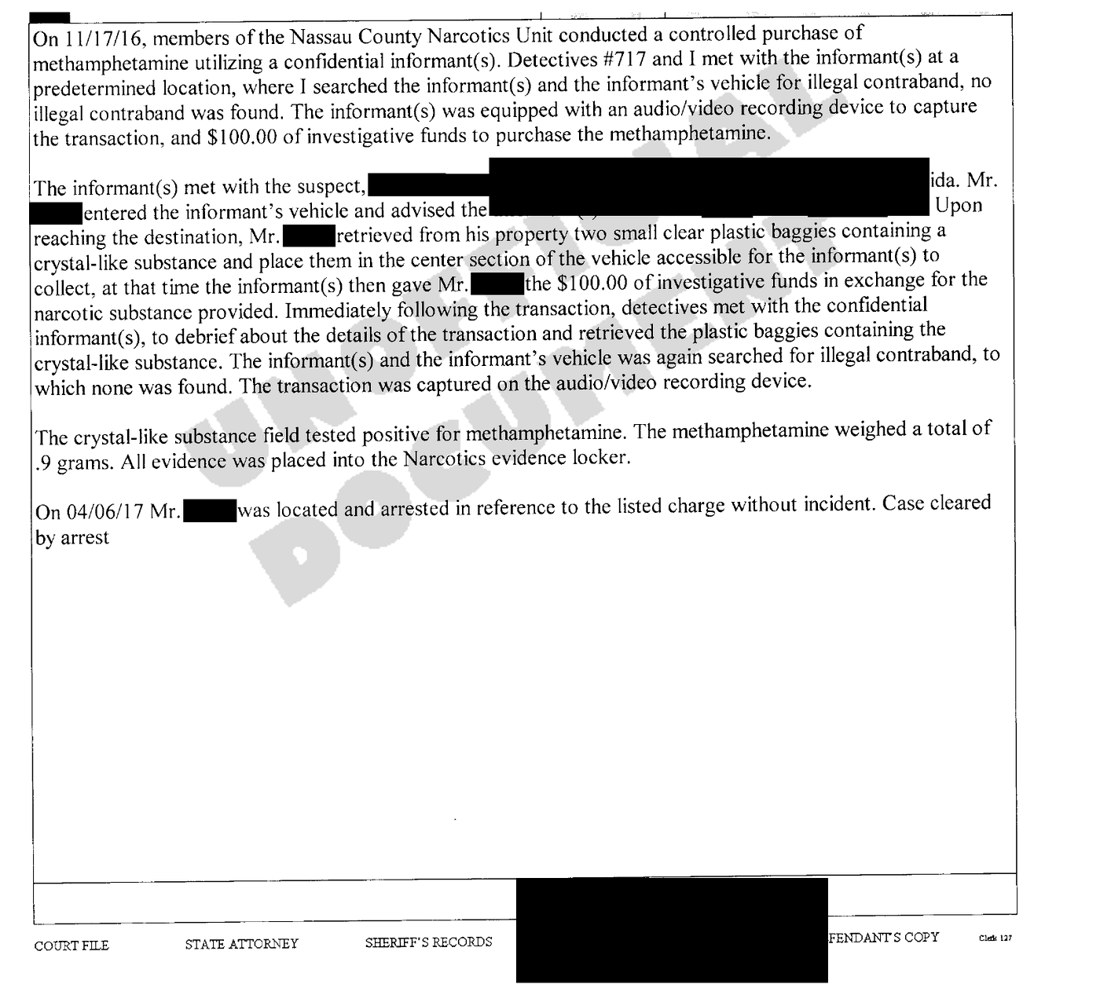
The Writer’s case began with $100 and less than a gram of methamphetamine.
In November 2016, Nassau County detectives sent a confidential informant to make another controlled buy.
According to the arrest report, the Writer got into the informant’s vehicle, directed him to another location and eventually placed two small baggies in the center console.
The informant handed over $100.
The substance weighed 0.9 grams and tested positive for methamphetamine.
The transaction had been recorded.
The report ended neatly:
Case cleared by arrest.
The Writer pleaded guilty and received ten months in the Nassau County jail.
That could have been the whole story.
Meth.
Money.
Recording.
Arrest.
Jail.
Next file.
From the file: the Writer’s 2016 methamphetamine controlled-buy report.
Then the Writer wrote to the judge.
He was not claiming innocence. He wrote that his sentence had been fair and probably lighter than he deserved.
He wanted a few more days of gain time.
A slightly earlier release.
A little sooner home.
He wrote about missing his wife and son. He wrote about working in the jail kitchen and on the road crew, attending church and AA, and trying to become a better husband and father.
Of course, he wanted something.
People generally do not write judges just to catch up.
But after enough narcotics reports, something strange happens when a defendant suddenly starts speaking in his own voice.
Until then, the people in these files are mostly functions.
Suspect.
Target.
Buyer.
Confidential informant.
The Writer becomes a person again.
The arrest report tells us he sold 0.9 grams of methamphetamine for $100.
His letter tells us he missed his kid.
Both things were true.
💨 · 💨 · 💨 · 💨 · 💨
And that may be the clearest picture of the Snitch Economy.
On paper, everything is wonderfully orderly.
The informant is searched.
The recorder is attached.
The money is issued.
The purchase is made.
The drugs are submitted into evidence.
Case cleared by arrest.
Out in Nassau County, it is considerably messier.
These are people who already know one another.
They have bought from one another, sold to one another, used drugs together, ridden in the same cars, sat in the same houses and saved one another’s numbers in their phones.
Then somebody gets arrested.
And somebody starts singing.
Police send him back into the same world carrying money and a recorder.
Someone trusts him.
Someone sells to him.
That person gets arrested.
Maybe that person starts talking too.
Sometimes the system produces a trafficking conviction.
Sometimes it produces 0.9 grams of methamphetamine.
And sometimes a confidential informant tells police that two men are going to Jacksonville to buy drugs and a gun from an unknown supplier—
and then turns out to be the supplier.
Not exactly organized crime.
Not exactly organized anything.
Just drugs, cops, informants, old acquaintances, new incentives and a recorder running quietly in somebody’s pocket.
Then somebody who recognizes the face at the door opens it.