Furman Clark, Fernandina Beach, and the polite fog Amelia keeps for uncomfortable things.
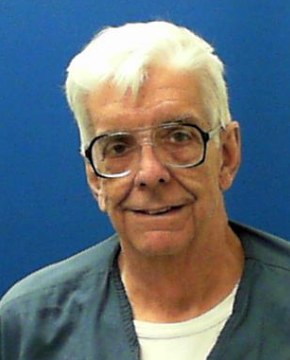
In the Florida Department of Corrections photograph, Furman Otis Clark Jr. does not look like a monster.
He looks almost pleasant.
White hair. Glasses. A faint, neighborly smile. The kind of man who might sit beside you at Rotary, shake your hand after lunch, and mention a development opportunity before the coffee cools.
But the story does not begin on Amelia Island.
It begins in the marsh.
Not on Centre Street. Not at Rotary. Not at a Fernandina dinner table where the wine is poured and everyone pretends not to know what everyone knows.
It begins with a Washington, D.C., lawyer, a $295,000 yacht for sale, and a stranger who said he wanted to buy it.
Furman Otis Clark Jr. Florida Department of Corrections photograph.
The Man in the Marsh
Julian Singman disappeared after agreeing to meet Furman Clark about the sale of his yacht, Calpurnia.
Singman was 56, Harvard educated, and accustomed to men practiced in concealing what they wanted. He was a Washington lawyer. He knew how to read a room.
He had already decided Clark did not feel like a serious buyer. According to a friend, Singman came away from him with a feeling that was difficult to name and harder to dismiss.
But a $295,000 yacht is not easily sold. A man may distrust another man and still decide that $295,000 requires dinner.
That night in Bal Harbour, just north of Miami, Singman went to meet Clark.
He was not seen alive again.
For nearly three weeks, Calpurnia waited at her berth in Washington, D.C., while the man who owned her vanished.
Then commercial crabbers working Turner’s Creek near Savannah noticed a body floating among the winter marsh grass.
The creek was wide, slow, and ruled by the tide. It had declined to carry Singman out to sea. It only moved him through the brown water until someone noticed.
He had been shot four times.
Police went less than a mile down the creek and arrested Furman Clark at the home of a man who had recently taken him in. Clark had already made himself familiar around Wilmington Island, drinking in smoky bars, talking about the yacht he expected to own, and arranging a berth for it beside the creek.
Police reportedly found the dead man’s possessions scattered through Clark’s life: his engraved watch, money clip, and credit cards. They found his blood on Clark’s clothing and inside his white pickup, along with spent ammunition and the gun used to shoot him.
While Singman was missing, Clark had allegedly begun wearing his identity. According to Folio Weekly, he drank on Singman’s credit and bought foul-weather boating clothes in Singman’s name. He had even reserved a berth for Calpurnia near Turner’s Creek.
Only the yacht escaped him.
The evidence looked less like a trail than a room Clark had forgotten to clean.
And still, the murder case would not hold.
Singman went to dinner near Miami. Three weeks later, his body was pulled from a marsh in Georgia, and the killing was left to rot in the jurisdictional gap between two states. No one could prove where he had been held, where he had been shot, or even in which state the killing occurred. Florida and Georgia each possessed part of the story. Neither possessed the whole crime.
This was 1985. Police departments hundreds of miles apart, divided by a state line, had no instant records, shared databases, or easy communication. Questionable warrants and careless work left holes the physical evidence could not close. The cold water confused the calendar. Most unsettling: an autopsy suggested Singman had eaten within hours of his death.
He had been missing nearly three weeks.
For some of that time, Julian Singman may still have been alive.
Where he spent those lost days, who fed him, and what passed between the dinner near Miami and the four shots near Savannah remain in the dark.
Clark admitted he possessed information that might have helped investigators. But he knew how to stand at the edge of a truth without stepping into it.
He entered an Alford plea to voluntary manslaughter, accepting conviction while denying the killing. At sentencing, he insisted he had nothing to do “directly” with Singman’s death.
Directly.
It is a small word. It carries a remarkable amount of luggage.
Clark pleaded guilty to manslaughter, not murder, and went to prison.
That distinction matters.
It also does not make the marsh grass any less cold.
The Record
Furman Clark was not particularly clever. He was bold, and for years that was enough.
Before Fernandina, Clark had already accumulated a public record that crossed state lines: fraud cases, bad checks, chamber-of-commerce irregularities, and a manslaughter conviction tied to Julian Singman’s death. Some accusations ended in convictions. Some did not. But the pattern was already visible.
By the time anyone finished counting, Clark had usually become somebody new in the next town.
Like a pirate surprised the fort had not fired back, Clark mistook survival for invincibility. So he did it again. And again.
The weekend before his arrest in Singman’s death, according to Folio, he stole a lawyer’s motorboat and carried it south. A man suspected of trying to take a yacht arrived with a stolen boat. Subtlety was never his gift. Nerve was.
Clark did not arrive in Fernandina with a past.
He arrived with a pattern.
The Second Act
Years later, after prison, after the Georgia marsh, after the kind of past most men would spend the rest of their lives trying to outrun, Clark came to Amelia Island.
And Amelia, being Amelia, made room.
Clark had left prison in 1996 and begun rebuilding.
He built fast.
By 2001, the unemployed ex-convict had transformed himself into something Amelia Island has always found difficult to resist: a wealthy developer with a grand vision and an even grander vocabulary for describing it. He and his business partner had built success through resort communities in North Carolina’s Outer Banks.
There are many ways to arrive here. Some people come by bridge. Some by boat. Some by inheritance, divorce, retirement, development scheme, or second act. Fernandina has always had a weakness for reinvention. That is part of its charm. People come here to become someone else.
The problem is knowing the difference between a past and a résumé.
Soon Clark was in Fernandina’s business bloodstream: properties, projects, offices, promises, and the bright language of development, that peculiar dialect in which risk becomes “vision,” land becomes “opportunity,” and old shadows disappear beneath confident vocabulary.
Fields Clark Holdings bought the old First Union Bank building on Centre Street for a reported $2.3 million and spent roughly $500,000 turning it into a corporate headquarters.
Clark announced plans to bring 18 construction and engineering companies to Fernandina. He handed out headshots and résumés, posed for photographs, and watched the Chamber of Commerce cut a ribbon.
Then came the invitation-only grand opening. Five hundred of the area’s most influential people reportedly attended. The champagne flowed while Clark described the prosperous future he intended to build for them.
Fernandina did not merely let Furman Clark through the door.
Fernandina put on its good clothes and came to his party.
He discussed 300 expensive homes around a Jack Nicklaus-designed golf course. He acquired Martin’s Island and envisioned private estates accessible only by boat or helicopter.
He joined the Rotary orbit. His former wife remarried him. Prison, disgrace, the dead man in the marsh: everything appeared restored.
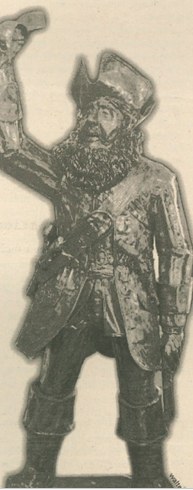
There was even a monument to the restoration.
The seven-foot, 300-pound bronze pirate Clark commissioned in his own likeness for the Centre Street headquarters. Archival image reproduced from Folio Weekly, November 20, 2001.
Sword raised and mouth open in a buccaneer’s cry, the seven-foot, 300-pound bronze pirate had been cast in Clark’s own image.
Fernandina celebrates its pirates, provided they remain safely picturesque.
Clark had himself cast in bronze.
The Packet
While Clark was away on a second honeymoon with the wife who had remarried him, plain envelopes began arriving at some of Fernandina’s better addresses.
Inside were old newspaper stories and court records from Georgia and North Carolina.
No one signed the packet.
Perhaps it came from an environmentalist, a business competitor, someone Clark had cheated, or someone who simply knew too much to stay quiet. By then, the island had accumulated reasons.
Amelia does not often accuse in its own name. It prefers an unsigned complaint, a confidential informant, a plain envelope without a return address. In a polite society, even the truth is expected to enter through the side door.
One packet reached Clark’s business partner, William Fields, who was already reportedly concerned about extravagant spending and company books that refused to come out right.
Within weeks, the partnership was over. Fields took the valuable projects. Clark was left with the diminished remains of another reinvention.
Local coverage called the split “different business philosophies.”
That phrase lay over the wreckage like a lace tablecloth over a body.
Clark admitted hiding his conviction. His résumé had reportedly turned his prison years into employment in real estate and engineering. He had not merely concealed his past. He had supplied Fernandina with a replacement.
In November 2001, Anne Schindler printed the story in Folio Weekly. The cover showed Clark’s face split in two. The title alone should have stopped every cocktail glass on the island halfway to someone’s mouth.
Schindler’s reporting remains the essential account of Clark’s hidden past.
But Folio had exposed the man.
What followed exposed the room.
The Polite Fog
Ten years later, Clark walked out of a Fernandina Beach Rotary Club luncheon and into another arrest.
There is something almost too perfect about that scene.
Not because Rotary did anything wrong. Quite the opposite. Rotary is respectability with a songbook: name tags, service projects, good works, polite applause, grown adults singing before lunch.
It is the sort of room Clark understood immediately.
If you can sit in that room, people assume you belong there.
This time, the money belonged to two couples who had invested $250,000 in companies Clark controlled. Investigators called the investments illusory. According to the arrest affidavit, Clark had presented himself as a successful developer and had not disclosed his prior felony conviction or financial problems.
The money had gone where money goes when a man is performing solvency: taxes, payroll, club dues, horses, medical bills, and old obligations.
Fernandina had been warned. Not in whispers. Not in back rooms. Not in the way island gossip arrives wrapped in “now don’t repeat this” and passes between respectable people at a church luncheon.
It had been warned in print.
The article was public, but the silence was communal.
It simply entered the polite fog Amelia keeps for uncomfortable things.
That fog is one of the island’s most reliable weather systems. It rolls in over old scandals, bad investments, civic hypocrisy, family embarrassments, and anything that threatens the postcard. It does not erase the record. It softens the edges until people can step around it without saying what they are stepping around.
Furman Clark did not test whether Fernandina could learn the truth.
He tested whether Fernandina could know the truth and still invite him to lunch.
And for a while, it did.
The Last Reinvention
In 2014, a Nassau County jury convicted Clark of organized fraud. He was sentenced to 20 years in prison. An appeals court affirmed the conviction in 2016.
The 2014 court file preserved a blunt description of the damage left behind: not only the money taken, but the trust used to take it.
From the court file: a victim-impact statement describing Clark’s method as moving into a small community, ingratiating himself, and taking advantage of those he befriended.
Florida Department of Corrections records later listed him as deceased.
His last sentence did not end with another company, another lunch, or another room willing to make space for him.
It ended in custody.
But the more revealing ending is quieter.
It is the lunch after the warning.
The handshake after the article.
The dinner invitation after the rumor.
The old island habit of lowering its voice around money, manners, and men who seem useful.
But there is a difference between forgiveness and amnesia.
A past can be forgiven.
A pattern should be studied.
And the warning had already been printed.
So look again at the photograph.
White hair. Glasses. The faint smile.
Not the smile of a movie villain. The smile of a man who knows how the room works — who learned that people do not always need to be fooled because sometimes they are willing to help with the illusion.
That may be the most chilling thing about Furman Clark.
Not that he smiled.
But that, for so long, Amelia smiled back.
Source Notes
Anne Schindler, “The Secret Life of Furman Clark,” Folio Weekly, November 20, 2001.
Peter Perl, “Mystery Shrouds Lawyer’s Death,” The Washington Post, March 6, 1985.
Michael Parnell, “Furman Clark accused of fraud,” News-Leader, 2011.
Susan Cooper Eastman, “Always a Con,” Folio Weekly, April 12, 2011.
“Man convicted in fraudulent land development scheme,” News4Jax, April 9, 2014.
Furman Otis Clark Jr. v. State of Florida, First District Court of Appeal, Case No. 1D14-3111, April 6, 2016.
Florida Department of Corrections inmate record preserved in the research file.